It's seven in the evening, a long day at work is behind me and I'm already thinking about a good TV series and a couch. Just when I want to rest, a loved one starts cleaning energetically. They say they don't need help. After a few minutes, I hear "“"Come help me do this"” or “help with this other thing too” and suddenly you find yourself in the middle of cleaning, even though you had planned a completely different evening.
This is the second story in my ATH series. In the first story I wrote about how ATH affects the perception of time and agreements, you can read that from here.
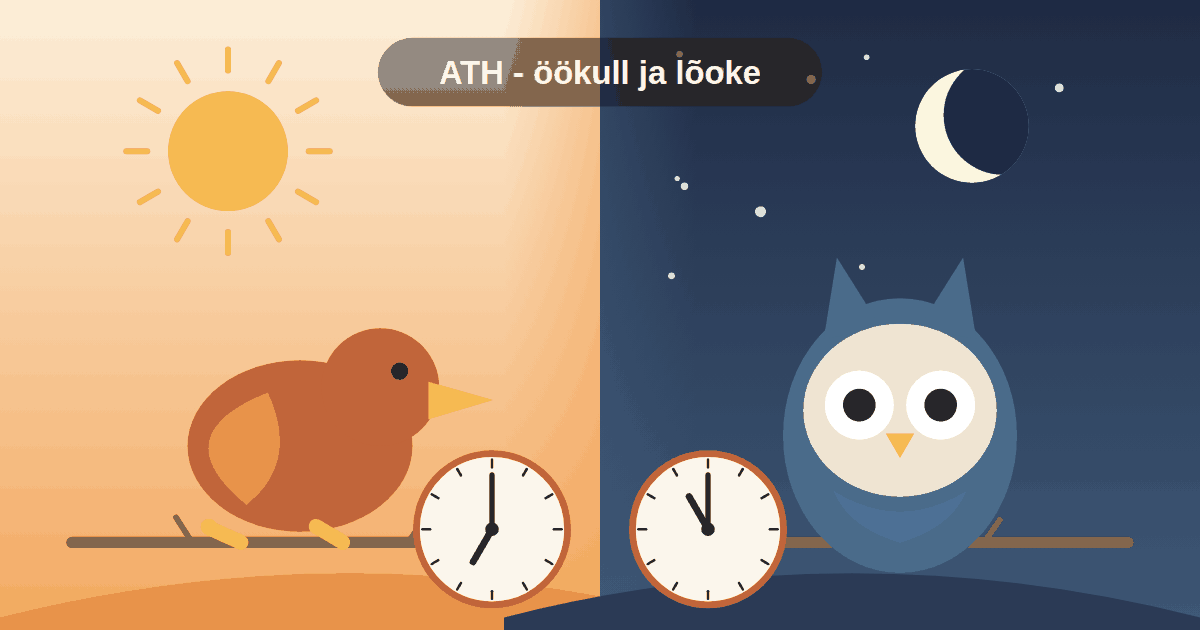
There’s something behind this that I didn’t understand for a long time: people with ADHD are often more night people than morning people. My own internal clock is the opposite, I work in the morning, I’m most functional then, and I leave the evening for my favorite activities. However, many people with ADHD have their main energy in the afternoon and evening, often going to bed after midnight. This is not a matter of will, studies confirm that ADHD often comes with a shifted circadian rhythm, with a tendency to be more of an “owl” than a “lark”. If you already feel tired by 7 o’clock, they have his best energy of the day yet to come.
Mornings are just as difficult
If I've been up for several hours in the morning, I'd already want to tell my partner about the day's events. But they ate still on their first coffee and aren't ready to socialize. I've learned to hold back and consider that for them, this time for socializing will simply come later.
It goes both ways. They have to take into consideration that when I come home after work, I need a few hours to ground myself and leave the workday behind.
Or if I make a noise when I'm up early in the morning, it disturbs his sleep. If I go to bed early in the evening, I might be disturbed by his nocturnal activities. Neither party is doing it to hurt the other, we just have different clocks.
How do I cope with this?
In view of the different wake-up and bedtime times, I initially tried to follow their rhythm, I was up for a long time, but in the end it drove me crazy that I had to wake up early in the morning, but they could sleep peacefully (sometimes even until half past noon). Since I was constantly tired and did not follow my own needs, I had to make changes in this regard. I started going to bed earlier and asked them to be quieter. I will be honest, at first I expressed myself passive-aggressively (e.g. when they landed in bed at 1 am with a crunchy bag of chips) and I am not proud of it. (NB! ADHDers are very sensitive to pressure and passive-aggressive expressions) Since they asked me to express myself nicely and I always want that myself, we discussed the needs of the morning and evening routines together. And you know what happened – my needs were met and their needs were met.
About cleaning.. I'm not a big fan of it, I like a clean home, but it's often hard to bring myself to do it. My friend is a cleaning freak! (NB! Probably not the most common thing with ADHDers). At first, I gave in more because I felt like I was leaving another person to clean alone (I felt guilty). But since she herself repeatedly said that she didn't need help, I quietly started practicing setting my own boundaries. If I can't, I'll say it honestly: “"I don't feel like it right now",Sometimes I help out on a smaller scale, sometimes I just let her clean up and try to rest without feeling guilty. If it bothers me that she's cleaning, I say so and suggest another activity together.
The emphasis is always on communication. Whenever possible, we give each other our space and make clear agreements, instead of trying to impose each other's rhythm to suit our own.
How can I help?
I support loved ones of people with ADHD who are looking for better understanding and ways to cope in everyday life. I don't give ready-made solutions or tell you what your relationship "should" look like, but I help you understand your feelings and find ways to stay in the relationship without losing yourself. Read more, What is peer counseling? and how it can help you in your daily life.
If you feel like talking about it, get in touch.
Recommended reading
- Distracted thoughts. Causes and recovery from attention deficit hyperactivity disorder – Gabor Maté. Written more from the perspective of the person with ADHD, but helps to understand what is really going on in the mind of a loved one – also a valuable read for a partner or family member.
Leave a Reply